Saturday, 14 December 2013

Original Footage in its Raw State


This is the raw footage from the ident which introduces my short film. I wanted the background to be completely black so that it actually looked like the Earth in space. When I filmed the shot the background was too bright on the right hand-side and some things can be seen faintly in the background on the left, so I used a tool in Adobe Premier Pro to create a circle effect that went around the Earth and gradually faded out so that the Plane could still be see going around the Earth, but the entire background was black.


This is the raw footage of the shot where Mallow is tidying his office in an attempt to make it look presentable for when Lotta walks in. I sped up the footage in Adobe Premier Pro by 250% to make it even more comical. A royalty free variation of 'We're in the Money' plays while during this shot which is also sped up. This was inspired by Benny Hill and is a good example of where my film is also a comedy, not just Film Noir. 

Props List

As my film is dependent on the way it looks more than anything, as I am trying to replicate Film Noir and make my film look as if it was made in the 1930's or 1940's, props were very much needed to make sure that the gumshoe's office (of which the majority of my film takes place inside) needed to look the part. The props that I requires to achieve this were:
  • Venetian Lattice Blinds
  • Lamps
  • Door
  • Desk
  • Cluedo Board
  • Cigarettes
  • Matches
  • Blank Firing Gun
  • Vintage Radio
  • Vintage Books
  • Vintage Stapler
  • Vintage File Case
  • Vintage Pens/Pencils
  • Globe
Luckily for me, as my father is a collector of things that are vintage or antique, he had many of these things already so it wasn't too much of an issue to create the office; we only needed a few minor props to complete the look. 


Friday, 13 December 2013

Film Poster

Here are two variations of my final film poster. When I was creating my film poster, I wanted to try to replicate conventional Film Noir posters, which tend to have an image or a few images of the main protagonist, or a few characters, posing in a dramatic way. The images are usually made to look as if they were painted, however are usually in a style so it is hard to tell whether it's a photograph or a painting. I took a screen shot from my short film; a shot of Mallow looking through Venetian blinds as Venetian blinds are a major signifier of Film Noir, but I also sued it as Mallow's facial expression is clearly dramatic. I put this image into Photoshop and tried to make the still look as if it had been painted in the style of Film Noir poster art,by using the 'Cut out' filter in 'Filter Adjustments', with the 'Brush Size' at '0' and the 'Brush Detail' at '10' to allow for the greatest quality on a screen shot from my film; a shot of my main protagonist looking through Venetian blinds (a very conventional Film Noir shot) to give it that slightly painted effect. 

I then put this into InDesign and I used the still as a background for my poster. I then found a font on Da Fonts called 'Betty Noir' which had a Great Gatsby-esque, 30's American style to it which I used for the title of the short film, 'The Huge Snooze'. I made the text white and red, to contrast with the black background, and added a grey 'Drop shadow' on the title to replicate the shadows consistently used throughout the short film, and Film Noir as a whole. I used the font 'Steeltongs' to create a cast list at the bottom of the poster. By putting the font into Caps Lock, each letter I pressed became a new title, for example 'C' with caps lock on became "Music by". This made the poster instantly more authentic as the specific font and the credits are always on film posters. I also added in a web address for the film as well as a Twitter and a Facebook address of which I photoshoped the Facebook and the Twitter logos to make them completely white so that they are still clearly representative of the two websites, but fitted in better with the poster. I also did this to the Film 4 and the Studiocanal logos and added them into my film poster to make the poster look as if the authentic. 
 
 
The cinemas that I decided to put on the posters as the cinemas that the film would be released in are specialised cinemas that would be likely to play short films; rather than major cinemas. This is the same for 'Sight & Sound' magazine which would be more likely to review a short film than a major magazine like 'Empire' would.


Wednesday, 11 December 2013

Location Recce


Production Details: The Huge Snooze: A short Film Noir.
Producer: Ciaran Davis


Details of Location:

A foot tunnel in London used to represent a foot tunnel in 1930’s New York. In this scene, the films main protagonist, PI Marshal Mallows runs down the tunnel towards the camera, and his hat comes flying off behind him.

Address:

Greenwich Foot Tunnel,
Greenwich,
London.


Advantages of location:

The main advantages of using the Greenwich Tunnel was that it is an old fashioned tunnel so fitted in with the 1930’s era; and also there isn’t any graffiti on the walls or signs that will make it clearly modern. There is nothing about this location that makes it obvious that it is not really a foot tunnel in 1930’s New York.

As the ceiling lights are the only form of light in the entire tunnel, as no sunlight gets in due to it being so far underground, the lights create an interesting shadow effect on the ceiling. This is perfect for Film Noir as the genre heavily focuses on light and shadow play.

Location Considerations (problems, timings, permission etc):

The only problems I faced while filming in this location was the amount of ordinary members of the public walking through the Tunnel while we were filming. This meant that we had to time the tunnel sequence perfectly, to not capture anybody in modern clothing or with modern objects, i.e. a ruck sake or a bike.


Details of Location:

This flat was used as the interior of the main protagonist, PI Marshall Mallows, office. 
Address:

37 Vicarage Way,
Colnbrook,
Slough,
London


Advantages of location:

The main advantage of this location was that it is my father’s flat, who played the main protagonist Marshall Mallows, so we did not have to hire out a suitable venue to film in, and it didn’t matter how long it took us to film the scenes.
Also, my father collects antiques which were perfect for bringing the set to life when I built the set to look like a stereotypical 1930’s New York detective’s office as conventionally seen in Film Noir.

Location Considerations (problems, timings, permission etc): 
There were no real issues with filming in this location, apart from the fact that the flat is so small; so the set and the filming equipment took up a lot of space.


Rough Cut of 'The Huge Snooze'


Here is a draft of my short film, The Huge Snooze. Despite this only being a rough draft with clear things that have to be changed, I made this just to show the standard I am currently working at. There are only a few clips, such as the cutaway clips to the door, the phone and the cluedo board, that I need to make longer. Most of the changed I need to do revolve around the audio, such as adding in some more sound effects when needed, such as a gun shot and a match strike sound, as well as cutting down Lotta's theme during the dialogue scene as well as making the variation of We're in the Money longer during the scene when Marshal Mallow is tidying his office. When these changed are done, this film should be complete however I am likely to find slight problems that need to be changed on top of that. 

Friday, 6 December 2013

Production Log: 06/12/13

I used the 'Cross Dissolve' effect to fade the 'One Rehearsal Pictures' Ident in at the beginning from black, and back out to black again after. This helped to replicate and parody the 30's 'Universal Pictures' Ident. I also used this to fade between shot 3.1 and shot 3.2; the shot of Marshal Mallow lighting the cigarette and the shot of him knocking his knee against the chest of drawers. I did this for two reasons. 1) Fading is a very conventional method used in Film Noir so I felt that it was necessary for me to use it at least one during the actual footage rather than just the film's ident, and 2) shot 3.1 is significantly darker than shot 3.2 so to have it immediately cut from one to the other didn't look right, and was, to me, a clear movie error. I used the 'Luma Waveform' to make sure that the black surrounding the Globe in the 'One Rehearsal Pictures' ident was completely black as before the background was ever so slightly noticeable. I also did this to make the parts of the walls of the alley that, Lotta was walking down, that the light didn't touch darker, and the parts that the light did touch lighter. This made the contrast of light and dark greater, and conventionally Film Noir. This also lit up the rain more and made it more clear; light shining on the rain is also very conventionally Film Noir.

I used the 'Brightness and Contrast' tool to make the opening sequence darker, as before hand it was noticeable that I filmed a screen. I also did this to make the shot of Mallow running through the tunnel, in the Montage sequence, darker as this emphasised the shadows greatly (as harsh shadows are conventional of Film Noir) Finally, there were many shots where I had to change the speed of the footage. The obvious one is the sped up shot of Mallow tidying his office, but I also had to change the speed of footage at various other points. For example, in the scene where Mallow is describing the way Lotta's looks, the camera zooms into her eyes when the narrator (Mallow) says "Her eyes were the kind of green that would make envy jealous..." the actress looks up towards the camera as the word "eyes" are said, as well as lifting up her eyebrows when the word "money" is mentioned. However despite the timing of this matching perfectly with the audio, the actress reacts by opening her mouth in shock before the narrator says "As for her breasts". This posed as an issue, however I was able to get around this issue by cutting the footage into two halves; the first half was from the beginning of Mallow's description of Lotta's appearance up until the description of her lips, and the second was from the end of the descriptions of her lips up until the end of the description of her breasts. For the latter, I slowed down the frame rate ever so slightly so that the actress reaction was in time with the audio, but not too much so that it is noticeably slower. The result was unnoticeable as the footage looked the same speed as before, despite the timing now being a few seconds slower.

Sunday, 17 November 2013

Production Log: 17/11/13

This week I have gone back into my MixPad audio file for my short film to make sure that audio matches up perfectly with the film, seeing as now I have all of the footage done to make sure that I can do this. 

I edited the sound of the plane flying around the globe for my Ident so that the sound appears to be coming closer, louder, then moving away which now lines up with the footage. My 'One Rehearsal' Ident sequence is a parody of the Universal Pictures ident of the 1930's and 40's. 

I also edited the sound of the traffic and the flickering neon sign so that they rise in volume whenever Mallow, the camera, and the audience's ear, were closer to the window, which similarly had to be louder when Lotta opened the door, as the camera was closer, than it was when she closed it during the two-shot. 

There were also various sound effects like a match being struck and the sound of Marshal's leg hitting the chest of drawers which were added in as the footage looked bare without it so I had to find various other sound effects that sounded perfect. All of the sound effects within the film have been added in; the only audio that was recorded by the camera is the dialogue scene between Lotta and Mallow. 

This dialogue, recorded on the camera mic (after the visuals were filmed) had to be extracted, I had to run through WavePad to convert it to mono and add the 'old fashioned' sound, then dropped into this soundtrack as the final track of the five, but precisely, so that the background music of Lotta's Theme exactly matched that playing was already playing as a separate track, so that the later could be faded out without any noticeable jump in the sound. From here, all I had to do was to match the audio file with the video. However, while editing the footage I noticed that the transition the dialogue in each shot would sound odd; and sometimes the dialogue would over lap when I was trying to make the audio continue from one clip to another; so in Adobe Premier Pro I used the 'Constant Gain' tool to make the transition a lot smoother as this made the audio fade seamlessly over each other. After this, the error was almost completely unnoticeable.

Monday, 11 November 2013

Production Log: 11/11/13

I have recently begun editing for my short film. Now that I have a complete audio track, of which I used during filming as a guideline for the actors to know what they should be doing during certain moments, as the camera's mic was only needed for the dialogue scene, most of the filming was done in a music video-esque style so for the majority of filming the mic was not required. As the original track was played out loud, this made it incredibly easy for me to match the footage to the soundtrack as the actors were perfect in keeping in time with the soundtrack, so all I had to do was listen to the soundtrack left on the footage and put the footage inline with the actual soundtrack. Of course, this did not flow perfectly throughout the entire film as some sections I had to make longer or shorter, but it did make the editing process significantly easier. I am using Adobe Premier Pro to edit the visuals for my video. As I filmed my movie in 'mono' and created the effects myself by lowering the amount of light the camera picked up. I will not have to add any effects to make the film look Film Noir in post-production.

Thursday, 31 October 2013

Production Log:31/10/13

This week, on the 28th and the 30th, all of the interior shots (the vast majority of my short film) and the remaining external shots (Of Lotta walking through the alleyway in search for Mallow's office). Here is a Prezi summary of what I did to create a conventional Film Noir short film:


Monday, 28 October 2013

Production Log: 28/10/13

Set building for the interior shots (the majority of the film) took place today. The set was created within my Father's flat. Our plan was to make a conventional 1930's New York detectives office; a location that is never not in Film Noir. Here is an example of the look we were going for:

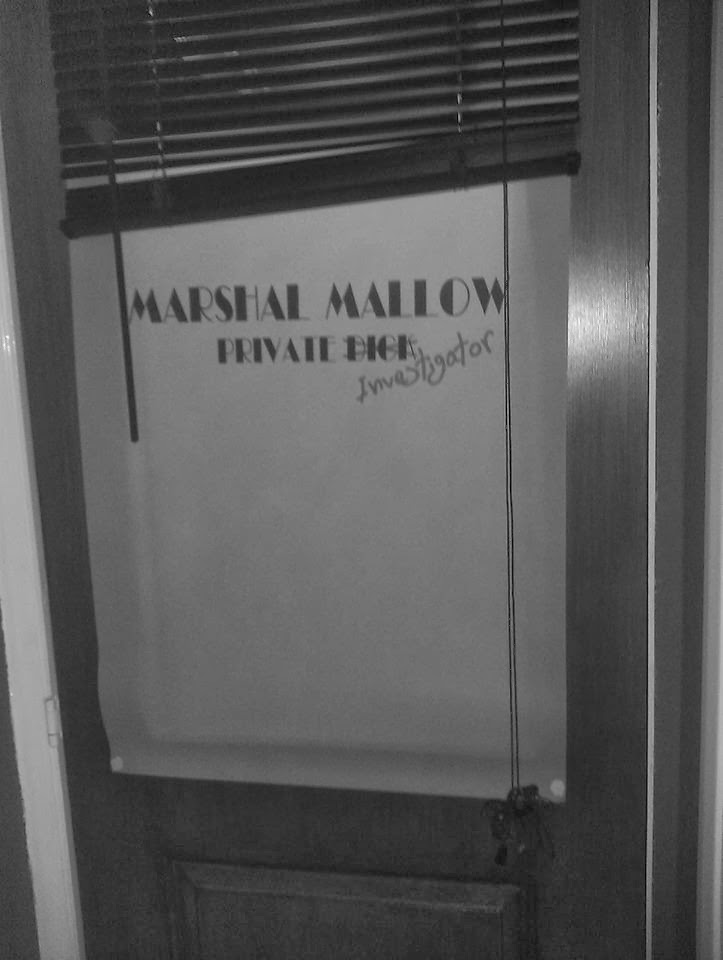
We started with the door. In the script, the Fem Fatale's silhouette is seen through the frosted glass of the door to Marshal Mallow's (the film's protagonist) door. We bought a cheap door and painted it brown to give it that varnished wood look, which we fitted to the doorway leading into the room. Then we purchased a large sheet of tracing paper of which we got the words "Marshal Mallow Private Dick" printed onto it, with the word "Dick" crossed out and the word "Investigator" written underneath it":


The tracing paper looks like frosted glass, as well as allowing for a silhouette to be casted clearly on it without blurring or distorting the figure: 


The text is purposely facing inside the room rather than outside the room, as it should be, as their is a later joke when the Fem Fatale calls Mallow "Wollam" as she reads his name in reverse. We also purchased Venetian blinds to a) Add more to the door, to make it more interesting, and b) to later double up as a Window when we took the tracing paper off for a later shot:


After this, I began to create the desk. Luckily, my dad is a collector of all things vintage and antique, so it wasn't difficult to find things that were accurate for the period in which the film is set; the 1930's. All of the props are from the right era; including a tin of Brasso, a Tin of Uncle Joe's Meatballs, a 30's Cluedo set, a vintage stapler with boxes of stables around it (these stables are larger than the ones we use today) and all of the books are either pre-30's or contemporary with the era; including The Big Sleep by Raymond Chandler; the book which the title of my film The Huge Snooze pastiches:


Monday, 21 October 2013

Production Log: 21/10/13

Today, I continued with my film poster. I added a cinema release date, claiming that the short film will only appear in selected cinemas. I also added film reviews from a film magazine a director and a film critic. I can happily say that from today my film poster is beginning to look a lot more legit; with a bold title, actor and directors name, steel tongs at the bottom, reviews, and a release date. All that needs to be done now is a film rating, the pictures of the actors (to also be edited) for film certificates to be added and for film company logos to be added. After all of this is done, I will move everything around if need be until I am 100% happy with the poster.


I also went back to the footage that I filmed a few weeks ago for the montage scene at the end of my short film and decided on which shot out of many that I took I likes most for a particular moment in the montage. The lighting in this tunnel that we filmed in, the Greenwich Tunnel, created a spiral effect of shadow around the tunnel which looks visually stunning. The mono effect on the camera only increases the contrast between the white tiles, capturing the light, and those that have shadows casted upon them. By chance, Marshal Mallow's fedora happened to full of, adding to the humour of the short film:


We replicated the hat falling off again in another shot which worked quite well, however I feel that I will use the former video as in this one, the hat falls off too early, their are people in the background (although their clothing cannot be identified, it is still an annoyance), there is a flashing bike light (which may look like neon so might work, however it might be obviously a bike light) and the run is TOO comedic, despite being a comedy, it's a little too much for this one:

Friday, 18 October 2013

Production Log: 18/10/13

After finding suitable copy-right free music, most of which came from Kevin MacLeod (The ones I used were ‘The Devil Rides Tonight’ (Which I used for the main title and the montage scene), ‘I Knew That Guy’ (Which was used for the section where Mallow was in his office alone for the beginning), and ‘Black Stockings’ (Which was used for Lotta’s (the fem fatale’s) theme.) These songs were also cut to size within the edit. I also used ‘We’re in the Money-The Gold Diggers Song’ from the movie ‘Top Hat’ (A very popular film from 1935, featuring Fred Astaire and Ginger Rogers) however I adjusted the speed and pitch to make it more comical, as well as only using a small section of it.

I then had to find suitable and royalty-free sound effects; of which I got from findsounds.com, sound-effect-library.com and pond5.com. The Diagetic Sound Effects had to be sourced, edited, and slotted in to match the footage. These included a DC3 propeller plane, which had to appear to be coming closer, louder, then moving away as it circled the globe of the One Rehearsal Ident sequence. (This was a parody of the Universal Pictures ident of the 1930’s and 40’s) Then there was the electrical short of the "neon sign with a nervous tick", which was a single, short spark sound effect, with I copied and arithmetically looped, to form the continuous sound throughout the office sections. This had to rise in volume when Mallow, the camera, and the audience’s ear, were closer to the window. Then there was the creaking wooden door, which similarly had to be louder when Lotta opened the door, as the camera was closer, than it was when she closed it during the two-shot. There were also various sound effects like a match being struck and the sound of Marshal’s leg hitting the chest of drawers which were added in as the footage looked bare without it. Finally, there was the freight train sound, with added doppler effect, and the specific sound of a gun being fired. All of the sound effects in the entire film were added in.

After I had all of the necessary audio that I requires, I used MixPad to mix the various audio clips and create the complete soundtrack - tracks including the Voice Over, Main Theme Music, Incidental Music, Foreground Sound Effects, Ambient Background Sound Effects, and, after the footage was filmed, I added the In-Camera Recorded Dialogue between Marshal and Lotta. All of these specific effects had to be precisely placed, and balanced for sound in with all of the other layers, so as to be audible, without overshadowing anything important. The Background Ambient Sound Effects Track was dedicated to the sound of traffic outside Mallow’s office. For this, I had to source the sounds of a variety of different car horns and engines from the era (1930s/1940s), together with police sirens, trams, bicycles, and such like, and layer them to create a realistic soundscape. No two vehicles are repeated, yet the sound runs throughout. Like the neon sign, the traffic ambiance has to rise in volume when Mallow is at the window, and also when his office door is open. Finally, the dialogue, recorded on the camera mic (after the visuals were filmed) had to be extracted, run through WavePad to convert it to mono and add the ‘old fashioned’ sound, then dropped into this soundtrack as the final track of the five, but precisely, so that the background music of Lotta’s Theme exactly matched that playing was already playing as a separate track, so that the later could be faded out without any noticeable jump in the sound. From here, all I had to do was to match the audio file with the video. However, while editing the footage I noticed that the transition the dialogue in each shot would sound odd; and sometimes the dialogue would over lap when I was trying to make the audio continue from one clip to another; so in Adobe Premier Pro I used the ‘Constant Gain’ tool to make the transition a lot smoother as this made the audio fade seamlessly over each other. After this, the error was almost completely unnoticeable.

Thursday, 10 October 2013

Production Log: 10/10/13

This week I have completed my visual progression and image systems posts: deciding on which props and costumes I will be using; I shall be using props that are associated with the 1930's-40's such as an old fashioned radio. The costumes will also be of this style, for example the gumshoe will be wearing a stereotypical detective outfit; suspenders, a tie, a fedora etc. I have access to props and costumes as I know people in the theater; as well as assess to experienced actors.

Traditionally in Film Noir, the protagonist will narrate the film and the visuals will act out what it is that he is saying; like in a music video, so when making my short film it was essential for me to have an audio track before I could start on the visuals. So, after my script was complete, I began production on the audio track by working with Craig Cameron-Fisher, the actor who played the protagonist Marshal Mallow, to make sure that the entire narration was perfect for how we wanted it. This took a couple of recordings as there were certain things we both didn’t like with the original; for example some parts he spoke without enough enthusiasm and it meant that the joke wasn’t delivered as well as it could have been. As Craig lives right near Heathrow, this meant that we had to record the audio after midnight when the planes had stopped flying. Then, by using WavePad Sound Editor, I was able to remove any unwanted sounds, such as breathing, coughing, unwanted crackle etc. I then cut up the audio into a few different sections, to distinguish each scene or shot.


Wednesday, 9 October 2013

Visual Progression and Image System in my Short Film

The visual progression that I will be using will be that the short film begins with the detective, Marshal Mallow, alone in his room; bored and poor as he hasn't had a case in ages. When looking out the window he noticed a woman, the fem fatale Lotta Clivage, walking towards his office...


...But than end with the dame entering the room, therefore their will be shot-reverse shots of the detective and the dame in conversation.


The image systems which I will be using will be be composed of 30's- 40's props, such as an old fashioned stereo, aluminium Venetian blinds etc. As well as old fashioned costumes. Hopefully, due to the Private Investigator stereotypical costume, the audience will gather that he is a detective.


Sunday, 15 September 2013

Production Log: 15/09/13

Recently I bought a white globe and this weekend I went over the edges of every country and island with a permanent marker to make them stand out. I then got the production ident, "A One Rehearsal Picture" (parody of "A Universal Picture"), printed onto it:


The reason for this is so that I can begin my short movie, which is a parody of Film Noir and made to look like it was created in the 30's -40's, with a parody of the Universal logo from the time. Universal made many of the popular Film Noir movies from that era: 


I cut a small slot in the side of the globe in which I fitted the end of the wing of a small plane figure, the same plane used in the above picture. As well as this adding to the parody, it also acts as a means of stopping the globe from spinning as the plane hits the globe's stand. The positioning between the plane and the text means that when the plane stops, the text will be inline with the camera to fully reveal the title. With accurate lighting, this effect should hopefully be achieved well. 

Sunday, 8 September 2013

Production Log: 08/09/13

Today's lesson was dedicated to working on the film poster that promotes my short film. As I am yet to take the photographs of my models, I was focusing purely on the text for now, and when those images are edited and added, I will then position the images and the text accordingly. 

I started creating a black background for the poster. As the film is to be Film Noir, the colour black would be fitting, as well as being conventional of Film Noir Posters. I found a font on Da Fonts called 'Betty Noir' which had a Great Gatsby-esque, 30's American style to it which I used for the title of the short film, 'The Huge Snooze' (A parody of the famous Film Noir film and detective book, 'The Big Sleep') I made the text white, to contrast with the black background, and created a grey shadow on the title to replicate the shadows consistently used throughout the short film, and film noir as a whole. Hopefully, from the poster alone, it should be clear that the short film is of the genre of film noir. 

When I have taken pictures of the models in 1930's 40's clothing, I plan to use an effect on photoshop to make the images look as if they were painted, as this, again, is conventional of film noir. 

Friday, 6 September 2013

Production Log: 06/09/13

Today was my first lesson back after the Summer and I have been playing around with Photoshop to learn how to create a Film Noir Poster effect. Film Noir posters tend to have images of the actors made to look as if they were painted. I recreated this by using the 'Cut out' filter in 'Filter Adjustments'. This has given me experience for when I come to creating my own movie poster which will be in the style of a Conventional Film Noir Movie Poster. Pre-sixties Film Posters were very often painted, so I wanted to recreate this to make a more authentic product; so that when one looks at my poster they instantly know that my film will be Film Noir. 

Original Image

Edited Image


Monday, 2 September 2013

Analysis of previous student's A2 work


The film begins with a series of close up shots of items within the room as well as of a man's; some sort of doctor, face. This, along with the diagetic sound of a ticking clock, adds suspense to the video. The shot then changes to reveal a man on a therapist chair, terrified as he tells this therapist about 'Him'. This also carries this mystery. When it is revealed that the man is scared of his own shadow, the suspense is broken by humour, however the audience is still confused as to whether or not the man is clearly sick and scared of his own shadow or not. The next scene is of the man walking towards his car, to find his car being driven away. This again illustrates a thrilling vibe, but again is broken when it is revealed that the man's shadow, a man dressed in a black morph suit and a top hat, is driving away in his car. The audience now clearly know that the genre of the film is a black comedy.

Research Equipment

For my short movie, I will be using the Canon EOS 550D to film it. With a 1080p HD video recorder, this camera will allow me to capture crisp footage to allow for the best quality footage. The handling of the camera is very easy due to the large rubber-coated handgrip and a large thumb-grip area on the back of the camera and the buttons and dial are very easy to understand and master, allowing me to be able to increase the contrast and lower the brightness, as well as putting the footage into monotone to allow for the perfect film noir look; pure white against deep black.  

Film Noir Audience Research


It is hard to define a specific target audience for my short film as it could be appreciated for many different reasons. To address the Reception Theory; the belief that a 'text', whether it's a book, a film, a video game etc. cannot be passively accepted by their audience, as all audiences are active, never passive, and is instead interpreted by them based on their own individual experiences and cultural background. For example, in the case of my film, the humour elements would more likely be understood by somebody from the western world than from the eastern as the main protagonist, Marshal Mallow, is a parody of the western, archetypal man. The cultural theorist Stuart Hall came up with three hypothetical models in which audiences read media text; the first being a Dominant (or hegemonic) reading: the audience are fully aware of the text's code and they accept the preferred reading of it that the creator intended; in my case a dominant audience would be somebody who can both understand the Film Noir cliches that have been parodied, as well as seeing the character of Mallow as a mockery of the sexist nature of the 30's - 40's American white male. The second model is a Negotiated reading: the audience partly accept the text's code and they broadly accept the preferred reading of the text that the creator intended, but they modify it to their own interpretation. So, in my case, a Negotiated audience would be somebody who understands some of the cliches of Film Noir that have been parodied but perhaps miss many as they're not as familiar with the genre as a Dominant audience would be. The last model is an Oppositional (Counter-Hegemonic) reading: an audience who has a completely opposite reading  to that of a dominant audience, usually due to their social situation. They tend to understand the preferred reading of the creator, but they but completely disagrees with it; bringing their own alternative frame of reference to it. An oppositional audience for me would be somebody who disagrees that I have parodied any cliches of Film Noir. Due to the cliches that I have parodied being very universally known as cliches of Film Noir, by those who actually know the genre, if somebody where to think that I haven't represented Film Noir at all than it would be more likely that they are just unfamiliar with the genre and therefore do not know it's conventions. An oppositional audience may disagree with my preferred reading of my film, that it is in fact a feminist text; due to it being an on screen illustration of Laura Mulvey's 'Male Gaze'- The belief that media texts are very much seen through the eyes of men by portraying women as sex symbols, by my use of actually having the camera as his own Point of View as Mallow's keeps staring towards the Fem Fatale, Lotta Clivage's cleavage. An oppositional audience may see this as sexist, rather than criticising sexism, by interpreting my intended message differently from how I would have preferred them to do so. If I were to have to choose a demographic for my film it would most probably have to be males aged 20-40 due to the sexually explicit humour and the fact that, as the film follows the story of Marshal Mallow rather than focusing too closely on Lotta Clivage, a male audience could perhaps relate to the lazy, sexually obsessed and money orientated attitude that Mallow has.

Film Noir Theory


Analysis of Film Article


Analysis of Short Film


SOUND
The non diagetic, ambient backing track instantly sets the tone of this short film by adding mystery to it; as well as ambient music often being associated with sci-fi. The sound effects for the games which the protagonist is playing are specifically technological and electronic to again, inform the audience that this short film is a sci-fi. 

MISE-EN-SCENE 
The futuristic, virtual reality game which the man is seen playing, as well as his eyes glowing with a silvery blue colour instantly informs the audience that this film is set in the not to distant future; where gaming is better but the house and the clothing which the man is in is still modern and recognisably normal upon today's norms.  

CAMERA
Certain shots are filmed as if they are from the perspective of the protagonist as he watched the television or cooks food. This, along with the futuristic boarder and app pop ups on the sides; similar to that of The Terminator, helps the audience to visualise the extent in which technology has evolved to within this sci-fi. 

EDITING
The constant switch between game play footage and the protagonist simulating the game makes it easy for the audience to know that he is playing the game. The animation that has been edited onto the footage, such as when the protagonist opens the fridge and a pop up informs him of what food is what by highlighting each item, as well as telling him the temperature of the fridge, has been, again, used to simulate that the film is set in the not so distant future.

Thursday, 22 August 2013

Production Log: 22/08/13

This weekend I went to London to do some filming for my short film. I went to Greenwich Tunnel to capture a running scene of the main protagonist for a montage scene at the end of my film. The lighting in the tunnel created a great spiral of shadow going through the entire tunnel, and due to the low ISO sensitivity, the tunnel appeared darker than it actually was in reality, so the spiral was more exaggerated and appeared as a deeper shadow. As the actor ran towards the camera, the separated lights created a flashing effect on the actors face as he got closer and closer, so his face would go from lit to shaded as he got closer and closer to the camera. This added drama to the shot, as well as being a very Film Noir-esque location to film in. Nicely lit creating a great contrast between light and dark, reflective tiles which capture the light, and an old fashioned look which works for the 1930's-40's setting of our movie. Due to the tunnel being constantly in use we had to time each take well making sure not to capture any members of the public in the shot. Luckily the darkness created by the low ISO sensitivity hid most of them when they were far enough away from the camera; or at least only captured them as faint silhouettes, so their clothing could not be identified as modern. I also filmed at the Chiswick Lamb Brewery, which is an old fashioned, black and white, tall building with a New York-eque fire escape and harsh lighting. A perfect location for Film Noir. However, the camera ran out of battery, so the shots I managed to capture were limited and poor, so I shall hopefully be returning at a later date. This location will have to be used again for other external shots. Raw footage of both locations will be added to the blog at a later date.

Tuesday, 13 August 2013

Production Log: 13/8/13

This week I did my storyboard for my short film by reading through the script and visualising in my mind what I want the shots to look like by putting the lights in the right place in relation to the camera and the actor/props that are the main focus of each shot, but making sure that the lighting still looks natural to the scene rather than forced. Doing this has allowed me to think up shots that are either conventionally Film Noir; such as putting lights behind lattice blinds to create effects on the walls, as well as shots that are clearly there for more comical/parody purposes, like having a Cluedo board stuck to the wall with red ribbon going in between the playing cards to resemble a detectives cork board as well as referencing a joke in the script. 

I used Celtx to create my storyboard, which was also used to write my script, as Celtx has a very easy to use storyboard maker that not only makes it easy to make sequences and add shots, with a selection of shot types to choose from, but it also allows for sketches of the shots to be drawn with a drawing tool, so that lines, circles and squares can be made, as well as having stock images of a man and a woman, a camera and different forms of lighting which makes the story board very clear to make out what the images are of, as well as making the story board easy to follow. Here is a frame from my storyboard: 


The black light represents a spot light, and the grey light represents a flood light. I hope to use an actual desk lamp as a form of flood light in my short film as my dad has an old fashioned lamp which would add to the mise-en-scene of the set as well as acting as an unforced form of light.